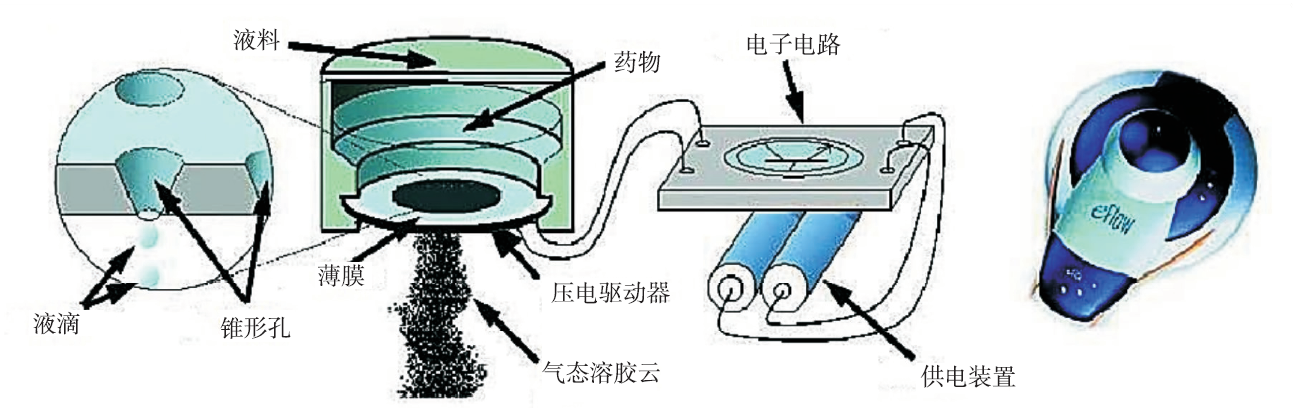
The pulmonary drug delivery system is a new drug delivery system developed in recent decade.Its composition and mode of administration are obviously different from those of the general preparation.The advantages of pulmonary drug delivery system include high local drug concentration,no first pass effect and fast drug absorption.Currently,it has become an important means of treating lung diseases and promoting the drug absorption of macromolecules.The drug categories,excipients,inhalation devices and clinical application of pulmonary drug administration were analysed by literature reviews.Furthermore,the research progress and characteristics of pulmonary drug delivery system in recent years were also summarized,which provide reference for further study of pulmonary drug delivery.
Key words:
Pulmonary drug delivery system
;
Carrier
;
Inhalation device
肺部给药系统(pulmonary drug delivery system,PDDS)是指药物经特殊给药装置直接进入呼吸道发挥局部或全身治疗作用的给药系统。由于肺部吸收面积大,降解酶少,肺泡通透性高,物质交换距离短,甚至蛋白质和多肽也可通过肺泡表面被吸收[1]。PDDS剂型包括定量吸入气雾剂、雾化剂和干粉吸入剂等,近年来多用于哮喘、肺气肿、慢性阻塞性肺疾病等的治疗。
TATSUMURAT,KOYAMAS,TSUJIMOTOM,et al.Further study of nebulisation chemotherapy,a new chemotherapeutic method in the treatment of lung carcinomas:fundamental and clinical[J].Brit J Cancer,1994,68(6):1146-1149.
[本文引用:1]
[26]
CHOU AJ,RENU GUPTA M D,BELL M D,et al.Inhaled lipid cisplatin(ILC) in the treatment of patients with relapsed/progressive osteosarcoma metastatic to the lung[J].Pediatric Blood Cancer,2013,60(4):580-586.
Abstract BACKGROUND: Osteosarcoma treatment failure is most often from the inability to control metastatic disease in the lungs. Encapsulating cisplatin within lipid complexes and delivering the agent via inhalation targets lung metastases with minimal systemic exposure. An open-label, phase Ib/IIa study was performed to characterize the safety and efficacy of inhaled lipid cisplatin (ILC) in recurrent osteosarcoma patients who only had pulmonary metastases. PROCEDURE: ILC was administered via nebulizer every 2 weeks (=1 cycle). Response was evaluated radiographically every 2 cycles. Cisplatin levels were measured in patients. When possible, metastasectomy was undertaken in patients after 2 cycles. RESULTS: Nineteen patients were treated. No patients experienced hematologic toxicity, nephrotoxicity or ototoxicity. Nausea/vomiting (≥grade 3) was attributed to study drug in one patient. Respiratory symptoms were observed in 13/19 patients with only one patient experiencing a ≥grade 3 respiratory symptom (not related to study drug). Systemic cisplatin exposure was minimal. Eleven patients had bulky disease, and all progressed prior to cycle 7. Eight patients had all lesions ≤2 cm. One patient had a sustained partial response. An additional two patients had stable disease after 2 cycles, underwent metastasectomy, and remained free from pulmonary recurrence 1 year after initiation of therapy. CONCLUSIONS: ILC is well tolerated in heavily treated osteosarcoma patients and did not appear to have the typical toxicities associated with intravenous cisplatin. Three of eight patients with less bulky disease had sustained benefit. Further study of ILC is warranted. Copyright 08 2012 Wiley Periodicals, Inc.
LEMARIEE,VECELLIOL,HUREAUXJ,et al.Aerosolized gemcitabine in patients with carcinoma of the lung:feasibility and safety study[J].J Aerosol Med Pulm Drug Deliv,2011,24(6):261-270.
ABSTRACT We investigated the biodistribution, pharmacokinetics, safety profile, and feasibility of aerosolized gemcitabine (GCB) in patients with lung carcinoma. Eleven patients with carcinoma localized in the lungs were studied in a dose escalation study of aerosolized GCB administered 1 day/week for 9 consecutive weeks. Safety data, scintigraphic assessment of the delivered dose and pharmacokinetic monitoring were analyzed. Patients were treated with doses of between 165mg/kg and 465mg/kg (dose in the nebulizer), using a new inhaler device (Aeroneb Pro with an Idehaler Chamber). The total dose of GCB delivered to the patient's lung was 42±16% of the initial amount of dose in the nebulizer. Safety data showed no hematologic toxicity, nephrotoxicity or neurotoxicity. At 465mg/kg, one patient experienced grade 4 pulmonary toxicity (bronchospasm), which was the dose-limiting toxicity. Grade 2 and 3 toxic effects included fatigue, vomiting, dyspnea, and cough. Overall response: minor response in one patient, stable disease in four patients, progressive disease in four patients. Pharmacokinetic data showed very low plasma GCB levels. Maximal plasma concentration was observed at the end of nebulization. Aerosolized gemcitabin was safe, with minimal toxicity, for patients with lung carcinoma.
D’LIMA DD,CHEN PC,JR C WC.Osteochondral grafting:effect of graft alignment,material properties,and articular geometry[J].Open Orthopaedics J,2009,3(1):61-68.
ABSTRACT Osteochondral grafting for cartilage lesions is an attractive surgical procedure; however, the clinical results have not always been successful. Surgical recommendations differ with respect to donor site and graft placement technique. No clear biomechanical analysis of these surgical options has been reported. We hypothesized that differences in graft placement, graft biomechanical properties, and graft topography affect cartilage stresses and strains. A finite element model of articular cartilage and meniscus in a normal knee was constructed. The model was used to analyze the magnitude and the distribution of contact stresses, von Mises stresses, and compressive strains in the intact knee, after creation of an 8-mm diameter osteochondral defect, and after osteochondral grafting of the defect. The effects of graft placement, articular surface topography, and biomechanical properties were evaluated. The osteochondral defect generated minimal changes in peak contact stress (3.6 MPa) relative to the intact condition (3.4 MPa) but significantly increased peak von Mises stress (by 110%) and peak compressive strain (by 63%). A perfectly matched graft restored stresses and strains to near intact conditions. Leaving the graft proud by 0.5 mm generated the greatest increase in local stresses (peak contact stresses = 6.7 MPa). Reducing graft stiffness and curvature of articular surface had lesser effects on local stresses. Graft alignment, graft biomechanical properties, and graft topography all affected cartilage stresses and strains. Contact stresses, von Mises stresses, and compressive strains are biomechanical markers for potential tissue damage and cell death. Leaving the graft proud tends to jeopardize the graft by increasing the stresses and strains on the graft. From a biomechanical perspective, the ideal surgical procedure is a perfectly aligned graft with reasonably matched articular cartilage surface from a lower load-bearing region of the knee.


 , 张华
, 张华