中国科技论文统计源期刊 中文核心期刊
美国《化学文摘》《国际药学文摘》
《乌利希期刊指南》
WHO《西太平洋地区医学索引》来源期刊
日本科学技术振兴机构数据库(JST)
第七届湖北十大名刊提名奖
美国《化学文摘》《国际药学文摘》
《乌利希期刊指南》
WHO《西太平洋地区医学索引》来源期刊
日本科学技术振兴机构数据库(JST)
第七届湖北十大名刊提名奖


 , 宋俊科, 杜冠华
, SONG Junke, DU Guanhua,
, 宋俊科, 杜冠华
, SONG Junke, DU Guanhua,

目的 研究枸橼酸爱地那非在不同性别来源的人肝微粒体体外代谢孵育体系中的代谢差异。方法 将枸橼酸爱地那非与不同性别来源的人肝微粒体进行体外共孵育,采用超高效液相色谱-四极杆-飞行时间质谱仪,鉴定并推测爱地那非在不同性别来源的人肝微粒体中的代谢产物。色谱柱为Acquity UPLC BEH C18(2.1 mm×100 mm×1.7 μm),流动相为乙腈与0.4%甲酸溶液,梯度洗脱,流速0.3 mL·min-1。采用电喷雾离子源,正离子模式检测。结果 结合色谱保留时间和质谱碎片离子信息,在体外肝微粒体孵育体系中鉴定了原型分子爱地那非,以及爱地那非经Ⅰ相代谢反应产生的8种代谢产物。所有代谢产物均为水溶性分子,无明显毒性结构。不同性别肝微粒体孵育体系中检测到的代谢产物种类相同。结论 建立了爱地那非的体外肝微粒体孵育体系模型,初步研究推测不同性别人群对爱地那非的肝脏微粒体代谢过程一致。
Objective To investigate the differences in aildenafil citrate metabolites in liver microsomes from different genders. Methods Aildenafil citrate were incubated with human liver microsomes from different gender

开放科学(资源服务)标识码(OSID)
磷酸二酯酶是有多种亚型的一类以磷酸酯为底物的水解酶,Ⅴ型磷酸二酯酶(phosphodiesterase 5,PDE5)主要分布于阴茎海绵体、肺、大脑、血管平滑肌细胞,血小板以及心肌细胞,可特异性水解环磷酸鸟苷(cyclic guanosine monophosphate, cGMP),从而调节阴茎和肺等器官或组织中血管平滑肌收缩力,参与血小板聚集过程,影响脑内cGMP信号传导途径[1]。2005年,美国食品药品管理局(FDA)批准PDE5选择性抑制药西地那非用于治疗肺动脉高压,缓解患者呼吸困难等症状[2]。PDE5选择性抑制药对于心肌梗死、心力衰竭等多种心血管疾病的治疗和预防作用也受到越来越多的研究和关注。
笔者在本研究建立不同性别来源人肝微粒体体外代谢孵育体系模型,通过超高效液相色谱-四极杆-飞行时间质谱技术,鉴定爱地那非代谢产物,探究不同性别人肝微粒体代谢差异,以期为扩大临床应用范围提供实验依据。
人肝S9,混合人源肝微粒体,男性肝微粒体,女性肝微粒体[购买自瑞德肝脏疾病研究(上海)有限公司,批号:X008023(人肝S9),X038076(混合人源肝微粒体),MX008064(男性肝微粒体),FX008064(女性肝微粒体)];枸橼酸爱地那非原料药(悦康药业集团股份有限公司,批号:019141102,);其他试剂与溶剂均为市售分析纯。
Waters CQUITY UPLC液相色谱系统,Waters Xevo G2 QTof质谱仪,Waters Acquity UPLC BEH C18色谱柱(2.1 mm×100 mm,1.7 μm,Waters,USA);高速冷冻离心机(美国Beckman);Eppendorf移液器(德国Eppendorf);Eppendorf离心机(德国Eppendorf)。
色谱条件:Acquity UPLC BEH C18色谱柱(2.1 mm×100 mm,1.7 μm);流动相:A为乙腈,B为0.4%甲酸溶液;洗脱程序:0~2 min(10% A),>2~47 min(10%→100% A) ,>47~52 min (100% A),>52~55 min(100%→10% A), >55~60 min (10% A);流速0.3 mL·min-1 ;进样量为5 μL。
质谱条件:电喷雾离子源,正离子模式;离子源温度100 ℃,脱溶剂气温度350 ℃,脱溶剂气流速600 L·h-1,锥孔气体流速50 L·h-1,锥孔电压30 V,毛细管电压3 kV,质量扫描范围m/z 50~1200。使用MassLynx V4.1进行数据采集与分析。
孵育体系终体积1 mL,其中人肝S9或微粒体蛋白质浓度1 g·L-1,爱地那非浓度100 μg·mL-1,以三羟甲基氨基甲烷盐酸(Tris-HCl)缓冲液(pH值=7.4)补齐体积。37 ℃预孵5 min,加入终浓度1 mmol·L-1烟酰胺腺嘌呤二核苷酸磷酸(nicotinamide ademine dinucleotide phosphate,NADPH)辅酶溶液启动反应。37 ℃恒温孵育 8 h。到达终点后加入5倍体积(5 mL)冰乙腈终止反应,振荡3 min,高速离心10 min,吸取上清液吹干。复溶后振荡离心,取上清液进样。对照组不加爱地那非,以Tris-HCl缓冲液代替,其余同上述处理过程。
①数据库的建立。使用ChemDraw软件绘制爱地那非化合物结构式,连同微粒体代谢可能发生的所有反应类型(包括Ⅰ相反应和Ⅱ相反应)等相关信息一起导入沃特世UNIFI 科学信息系统平台系统,形成数据库;②获得初步鉴定结果。由UNIFI软件根据导入的信息自动鉴定识别可能的代谢产物,并设置过滤器参数对识别结果进行初步筛选,过滤掉响应值<2000、精确质量数误差>10×10-6的化合物,得到初步的化合物鉴定结果;③人工识别和鉴定。参考已有文献报道,结合爱地那非质谱特征、相对保留时间、精确分子质量、分子式和多级质谱碎片等信息,对初步鉴定结果进行验证核查,得到最终代谢产物鉴定结果。
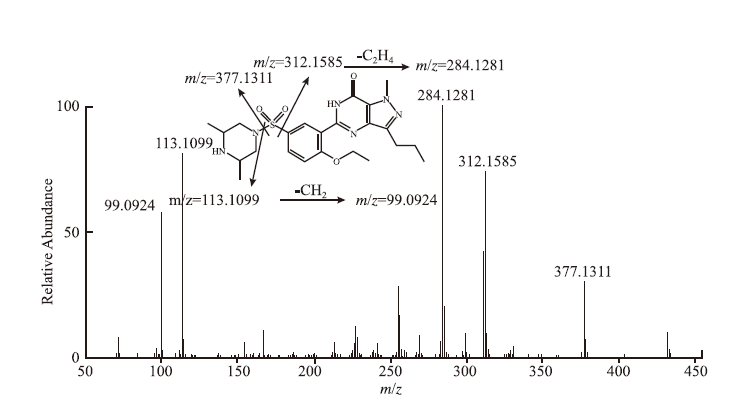
采用LC-MS方法检测爱地那非色谱和质谱裂解行为。保留时间13.6 min,准分子离子峰[M + H]+为m/z 489.227 9,分子式为C23H32N6O4S,见
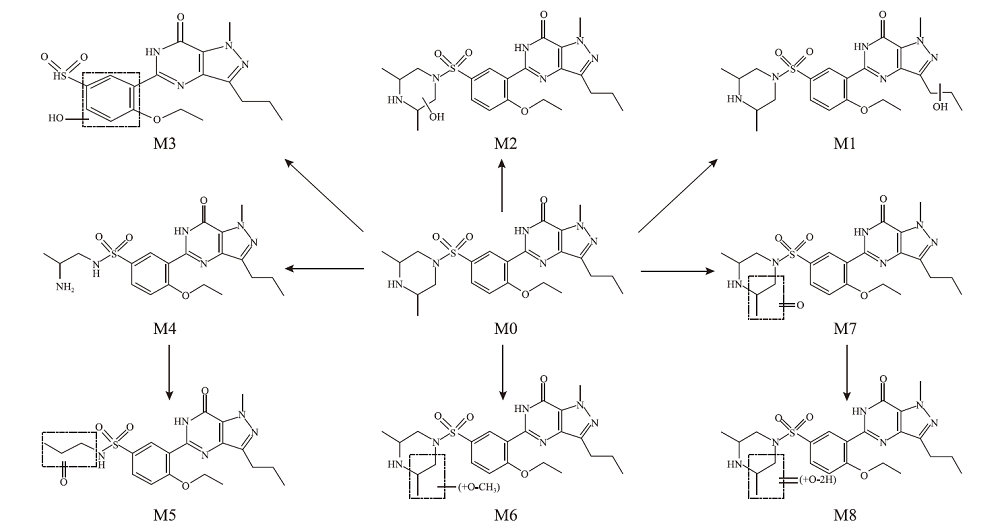
在NADPH存在的体外人肝微粒体孵育体系中,爱地那非产生了多个代谢产物。

表1 爱地那非及其在人肝微粒体中代谢产物的质谱表征
Tab.1 LC-MS/MS characterization of aildenafil and its metabolites identified in human liver microsomes
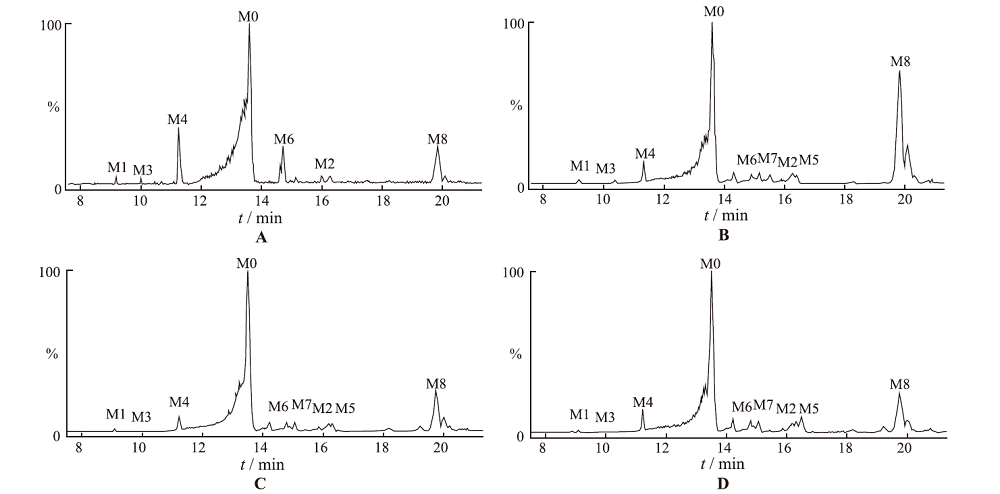
图2
爱地那非体外代谢8 h色谱图
A.人肝S9代谢;B.混合人源肝微粒体代谢;C.男性肝微粒体代谢;D.女性肝微粒体代谢。
Fig.2
Chromatograms of the
A.human liver S9;B.mixed human liver microsomes;C.male liver microsomes;D.female liver microsomes.
M1和M2 为爱地那非的羟基化产物。M1和M2的准分子离子峰m/z 505.2228比原准分子离子高15.9949 Da,分子式为C23H32N6O5S,表明原分子中引入了一个氧原子。M1的二级质谱解析中包括碎片离子m/z 487.2310(C23H31N6O4S,-H2O),375.1121,310.1525,282.1216,113.1055,99.0945。其中m/z 375.1121(C17H19N4O4S), 310.1525(C17H17N4 O2),282.1216(C15H13N4 O2)比原分子的离子碎片m/z 377.1311(C17H21N4O4S),312.1585(C17H19N4 O2),284.1281(C15H15N4 O2)低2 Da(-2H),表明羟基的引入位置是吡唑吡啶结构中的丙基侧链。碎片离子m/z 113.1055,99.0945与原分子相同,表明M1中哌嗪结构完整。而与M1不同的是,M2中碎片离子m/z 377.1272,312.1657,284.1281与原分子相同,而m/z 111.0959(C6H11N2)比原分子的碎片离子m/z 113.1099(C6H13N2)低2 Da,表明M2的羟基化发生在哌嗪结构中。
M3为爱地那非中的N-S键断裂并引入羟基的产物。M3的准分子离子峰m/z 393.1227,比原准分子离子低96.1052 Da,元素组成为C17H20N4O5S,且不存在碎片离子m/z 113.1099和99.0924,表明哌嗪环丢失,吡唑吡啶结构中引入一个羟基。M3的碎片离子m/z 365.1019元素组成为C15H17N4O5S,表明苯环上C-O键断裂,丢失C2H4结构。 碎片离子m/z 312.1657和284.1348与原分子相同,表明羟基在C-S键断裂后裂解,推测羟基被引入到与C-S键相邻的碳中。
M4为爱地那非的N-N'脱烷基产物。M4的准分子离子峰m/z 449.1966比原准分子离子低40.0313 Da,元素组成为C20H28N6O4S,表明原分子丢失了C3H4结构。M4的二级质谱中存在碎片离子m/z 377.1311,312.1694,和284.1315,而不存在m/z 113.1099和99.0924,表明哌嗪环结构破坏(N,N'-脱异丙基)。
M5为M4脱氨基并发生羟基化的产物。M5的准分子离子峰m/z 448.1649比M4的准分子离子低1.0371 Da,元素组成为C20H25N5O5S,表明在M4分子基础上发生脱氨基变化的同时又引入一个羟基。通过碎片离子m/z 377.1311,311.1547,283.1222的存在推定羟基的引入位置在破坏后的哌嗪结构中。
M6是爱地那非的羟基化和去甲基产物。M6的准分子离子峰m/z 491.2071比原准分子离子高1.9792 Da,元素组成为C22H30N6O5S,表明丢失甲基(-CH2)并引入氧原子。M6的二级质谱中存在碎片离子m/z 377.1272,311.1511和284.1349,而不存在m/z 113.1099和99.0924,表明在哌嗪结构中发生了羟基化和甲基丢失。
M7为爱地那非的羟基化和脱氢产物。M7的准分子离子峰m/z 503.2071比原准分子离子高13.9792 Da,元素组成为C23H30N6O5S,表明结构上引入一个羟基并脱去两个氢原子。M7的碎片离子m/z 111.0916比原分子的碎片离子m/z 113.1070(C6H13N2)低2.0154 Da,其他碎片离子m/z 377.1351,311.1582和284.1349与原分子相同,表明在哌嗪结构上发生脱氢变化并引入了氧原子
M8为M7的脱氢产物。M8的准分子离子峰m/z 501.1915比M7的准分子离子低2.0156 Da,元素组成为C23H28N6O5S,表明在结构上失去两个氢原子。M8的二级质谱结构与M7相比缺少碎片离子m/z 111.0916,说明失去的氢原子来源于哌嗪结构,脱氢变化后哌嗪结构被破坏。
研究表明,西地那非在小鼠体内的的免疫调节作用存在药动学和药效学相关的性别依赖性差异[11]。因此,在爱地那非的开发过程中,性别差异性研究十分重要。
本研究采用UPLC-Q-TOF MS法,最终共鉴定代谢产物8种,均为水溶性,无明显毒性结构的Ⅰ相代谢产物。其中M7(羟基化并脱二氢产物)和M8(M7进一步脱氢产物)为首次报道的代谢产物。
3种不同性别人肝微粒体孵育体系检测到的代谢产物种类一致,表明爱地那非在不同性别人群肝脏微粒体代谢过程中不存在代谢产物差异。由此推测,不同性别的人群对爱地那非的肝脏代谢过程一致,女性患者在服药过程中,不会因肝微粒体代谢过程而增加未知副作用。人肝S9样品中发现6种代谢产物,多为相对含量较高的代谢产物,推测这与人肝S9中酶成分较肝微粒体更为复杂,酶含量相对较低有关。
开展爱地那非的药物代谢性别差异研究,可以帮助阐明药物的毒副作用,对于药动学、药效学和药物的安全性评价等研究具有重要意义,为新适应证的开发提供了数据支持,同时为体外实验的结果外推至体内试验提供了理论支持。
| [1] |
PDE5 belongs to a superfamily of enzymes that catalyzes the hydrolysis of cyclic nucleotides cAMP and cGMP to the corresponding 5-nucleoside monophosphate. PDE5 takes part in many physiological and pathological functions, therefore selective PDE5 inhibitors are potentially useful for a variety of pathologies. At the present, PDE5 inhibitors available on the market have been used for the treatment of erectile dysfunction but, at the same time, are in clinical trials investigating other pathologies such as pulmonary arterial hypertension, coronary vasospasm, benign prostatic hyperplasia etc. This review analyzes the PDE5 inhibitors currently in clinical use, the drugs in clinical trials and the most representative chemical classes published in literature in this last decade.
[本文引用:1]
|
| [2] |
The discovery of the nitric oxide/cGMP pathway was the basis for our understanding of many normal physiological functions and the pathophysiology of several diseases. Since the discovery and introduction of sildenafil, inhibitors of PDE5 have been the first-line therapy for erectile dysfunction (ED). The success of sildenafil in the treatment of ED stimulated research in the field of PDE5 inhibition and led to many new applications, such as treatment of lower urinary symptoms, and pulmonary arterial hypertension, which are now approved indications. However, PDE5 inhibitors have also been used in several other disorders not discussed in this review, and the fields of clinical use are increasing. In the present review, the pharmacological basis of the NO/cGMP pathway and the rationale and clinical use of PDE5 inhibitors in different diseases are discussed.
[本文引用:1]
|
| [3] |
|
| [4] |
|
| [5] |
|
| [6] |
|
| [7] |
|
| [8] |
A novel method which involved dispersive liquid-liquid microextraction (DLLME)-back extraction based on ionic liquid (IL) was developed for the determination of three phosphodiesterase-5 (PDE-5) inhibitors, sildenafil (SD), vardenafil (VD) and aildenafil (AD), in human plasma. DLLME based on IL as the extractant solvent and methanol as the dispersive solvent was the first step to extract PDE-5 inhibitors from sample solution; the other step of back extraction was followed by transferring target analytes from the IL to acidified aqueous solution. This two-step extraction ensured the compatibility of the final extractant phase, acidified aqueous solution herein, with the reversed phase high performance liquid chromatography-UV detection, and afforded clean extractant phase. The optimal extraction condition was obtained after systematical optimization. The sample solution (960muL) was extracted by 20muL of 1-octyl-3-methylimidazolium hexafluorophosphate in the presence of 20muL methanol and 300mgmL(-1) NaCl with the assistance of vortex; IL phase enriched with the target analytes was then extracted by 10% acetic acid aqueous solution. Good linearity ranges (SD 1-500ngmL(-1), VD 2-2000ngmL(-1) and AD 2-2000ngmL(-1)) with suitable r(2) (=0.9999) were achieved. Limits of detection (LODs) in pure water were 0.15ngmL(-1), 0.30ngmL(-1) and 0.43ngmL(-1) for VD, SD and AD, respectively. Intra-day and inter-day relative standard deviations were below 6.38%. Finally, this method was applied for the determination of PDE-5 inhibitors in human plasma with satisfactory LODs of 0.92ngmL(-1), 1.19ngmL(-1) and 2.69ngmL(-1) for VD, SD and AD, respectively. Acceptable absolute recoveries were obtained from 100.4% to 103.9%. The developed method afforded a convenient, fast and cost-saving operation with high extraction efficiency for the test analytes. It has potential to be applicable to biological samples.
[本文引用:1]
|
| [9] |
A simple, sensitive and specific liquid chromatography/tandem mass spectrometry method for the quantitation of aildenafil, a new phosphodiesterase V inhibitor, in human plasma is presented. The analyte and internal standard, sildenafil, were extracted by a one-step liquid-liquid extraction in alkaline conditions and separated on a C(18) column using ammonia:10mM ammonium acetate buffer:methanol (0.1:15:85, v/v/v) as the mobile phase. The detection by an API 4000 triple quadrupole mass spectrometer in multiple-reaction monitoring mode was completed within 2.5 min. The calibration curve exhibited a linear dynamic range of 0.05-100 ng/ml with a 10 pg/ml limit of detection. The intra- and inter-day precisions measured as relative standard deviation were within 8.04% and 5.72%, respectively. This method has been used in a pharmacokinetic study of aildenafil in healthy male volunteers each given an oral administration of one of the three dosages.
[本文引用:1]
|
| [10] |
Aildenafil, 1-{[3-(6, 7-dihydro-1-methyl-7-oxo-3-propyl-1H-pyrazolo [4, 3-d] primidin-5-yl)-4-ethoxyphenyl] sulfonyl}-cis-3, 5-dimethylpiperazine, a phosphodiesterase type V enzyme inhibitor (PDE5I), is under development for treatment of erectile dysfunction (ED). The purpose of this study was to elucidate metabolism of aildenafil in vivo in rats and in vitro in mouse, rat, dog, and human liver microsomes. Thirty-one phase I metabolites have been found by LTQ/Orbitrap hybrid mass spectrometry in rat urine, faeces, and bile after oral administration. Major biotransformation pathways of aildenafil included N-dealkylation of the piperazine ring, hydroxylation and dehydrogenation, aliphatic hydroxylation and loss of alkyl group of piperazine ring. Minor pathways involved hydroxylation on the phenyl ring, pyrazole N-demethylation, O-deethylation, loss of piperazine ring (cleavage of N-S bond) and dehydrogenation on the piperazine ring. Similar metabolic pathways of aildenafil were observed in the incubations of liver microsomes from mouse, rat, and dog as well as from human. The depletion rate of parent drug in mouse and rat liver microsomes was significantly different from that in human liver microsomes. The cytochrome P450 reaction phenotyping analysis was conducted using isozyme-specific inhibitors. The results indicated that CYP3A was the main isoenzyme involved in oxidative metabolism of aildenafil. Overall, these in vitro and in vivo findings should provide valuable information on possible metabolic behaviours of aildenafil in humans. Copyright (c) 2013 John Wiley & Sons, Ltd.
DOI:10.1002/dta.1564
URL
[本文引用:1]
|
| [11] |
|